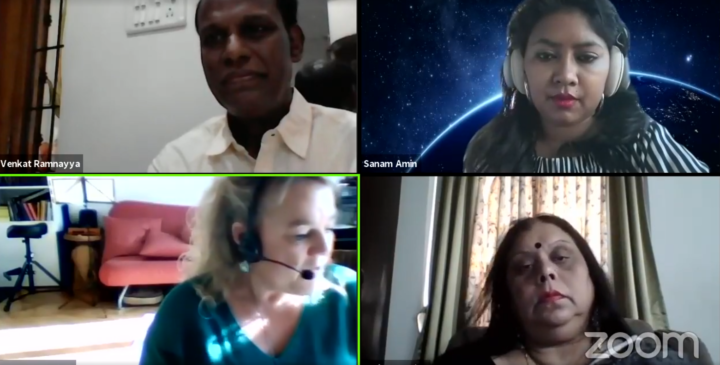
An online panel discussion, co-organised by WIDE and the Paulo Freire Zentrum in the framework of the Austrian Development Conference 2020, held on Friday 13 November 2020, gathered experts to discuss about the COVID-19 crisis in Asia, with a special focus on India.
The speakers were Sanam Amin (an independent consultant with a background in international human rights law, based in Thailand), Venkat Ramnayya (an agronomist with a longstanding expertise in rural community development, India) and Paula Banerjee (professor at the University of Calcutta and president of the International Association for Studies in Forced Migration). The discussion was facilitated by Petra Dannecker, professor and head of the Institute for International Development at the University of Vienna.
In her introduction, Petra Dannecker highlighted that not all countries have been affected in the same way by the COVID-19 crisis. The cases of COVID-19 seem to have exploded especially in countries where the inequalities between the rich and the poor are very high.
In the course of the discussion, the panellists elaborated on how the COVID-19 crisis profoundly increases global inequalities. They spoke about the relation and the extent to which this crisis is linked to climate change, and on the intersections of the health crisis with gender and the social and migratory status of people.
Twin disasters.
According to Venkat Ramnayya, the global COVID-19 pandemic has very severe consequences for people, such as very high levels of stress due to economic constraints, psychological tensions, health issues, domestic violence or sexual abuse. It is also closely linked to the climate crisis, being what he called “twin disasters”. In India, many people who have lost their jobs and went back to their rural regions of origin have recently lost their homes due to natural disasters related to the climate change. The country also faces high levels of pollution which are a big challenge for the population and public health. Ramnayya regrets the global lack of news coverage on climate change and its disastrous consequences, compared to COVID-19. Moreover, the fight against the climate crisis is a common global responsibility, including by the USA and the EU.
Sanam Amin confirmed the view that the climate crisis and the global pandemic are connected and intertwined. For her, the solutions for both go hand in hand. She appealed to invest in public health, a sustainable food system and ecology. She called for a systemic approach because the pandemic deepens inequalities and weakens the ability to deal with the increasing climate challenges.
Also for Paula Banerjee, ecology and the economy are fully interconnected. She recalled that during the two months of lockdown, India was hit by one of the worst typhoons which has devastated several villages, affecting entire communities. The most challenging current problem is not just the COVID-19 crisis, but the kind of development devoted to the rich. Consequently, she asked to rethink the economy from a sustainability perspective.
Women’s rights.
Sanam Amin emphasized that women´s issues go unnoticed in the course of the pandemic, while women are affected in so many aspects of their life: their economic situation, work, health, security, family. In many aspects, women are in the front line. The lockdown put a disproportionate burden of care work on women with up to four times more labour.
Paula Banerjee reminded the audience that in India, 90% of women work in the informal sector, and 80% of essentials workers are women. Many women workers have lost their jobs, but they have no support from the government. It is also not enough recognized that women are food producers and providers – but not land owners. Many women farmers go hungry; they don’t have enough food or money for their families because harvests could not take place due to the lockdown.
On top of that, inequalities are still increasing. Sanam Amin pointed out the fact that many millionaires around the world have made a lot of money since the beginning of the pandemic, while the working conditions in the supply chains of transnational companies are highly problematic.
Both Sanam Amin and Venkat Ramnayya pointed out that women do not only face economic stress due to unemployment but also social stress from domestic violence. Ramnayya stated that there was a rise of domestic violence in villages up to 100% in March 2020, and many family issues related to the increased burden of women with unpaid care work. Moreover, because of the patriarchy, women often do not go to school, therefore high inequalities and income gaps will persist. 56% of all Indians are estimated to live below the poverty line, what means that half of the population cannot satisfy their basic needs (social security, sanitation, housing, health care, basic food, energy, education, water). He criticized that the system of national accounting (GDP/ GNP) is based on marketized goods and services, but the contribution made by the women as food providers in South Asian countries is totally ignored, as there are no statistics that would reflect the real contribution of women to the economy.
Migrants and political tensions.
According to Paula Banerjee, the migrant population in India represents 400 million of people. When the Indian prime minister Narendra Modi declared the lockdown in March, he did not plan for these 400 million people. Many of them were women who lost their jobs and had no place to go to. Many tried to reach their communities of origin, but as transport was unavailable, they walked for days and weeks under extreme heat and without food or water. There were solidarity initiatives and some support, but it did not reach all and many people died on the way.
In terms of discourse, Banerjee explained that the notion of “social distancing” is highly problematic. She explained that “social distancing” has been practiced in India for hundreds of years. “The migrant workers are largely composed by lower castes people and we did not care for them, and now the situation is very critical for the poor, the lower castes, the indigenous communities and by correlation, the women.”
This situation has brought political tensions and a nationalist discourse. Banerjee regrets this political response, “because to bring up identity tensions leads nowhere whereas we have to fight such a crisis”. For Banerjee, solutions rather come from the civil society, for example Pakistani and Indian people working together in the face of this crisis, no matter what the political tension are.
Nationalist and authoritarian responses.
According to Sanam Amin, there is a heavy weight on migrant workers who were not supported in many countries. This crisis should lead to more consciousness on health as a global public good, but many countries have reacted with very nationalist responses. The situation presented an opportunity for authoritarian regimes to use the pandemic as a reason to crack down the fundamental freedoms. Draconian measures and disproportionate responses have been taken, with public health clearly not being the purpose. For example, Malaysia arrested workers who were protesting for adequate working conditions with a minimum of distance to others, but they were sent to jail, where the ‘social distancing’ is not respected at all. The same holds true for China where currently so many people from the Muslim minority are kept in detention camps. It is a very worrying situation in terms of repression of minorities. Military budgets should rather be allocated to fund health and care needs, for public goods and public services that are really necessary.
South East Asia accounts for 60% of the world’s population, but it is not the region where we find the most cases of COVID-19. Some countries like Thailand or Vietnam have invested in public health care infrastructures in the past. But at the same time, there are several countries with very low social protection. And in regions that depend on tourism, people find themselves in desperate circumstances.
Conclusions.
To conclude, it seems that women are those who lost the most from these interconnected crises. Indeed, the lockdown has put an additional burden on their care work. Many women have lost their jobs and lack access to rights due to patriarchal norms, while repeated natural disasters have increased their daily life difficulties as family food providers. Migrants women are left aside, and on top of that, most of the current gender equality demands have been invisibilized by the global media coverage of the COVID-19.
More information:
Documentation of the panels of #webET
About the author:
Margaux Bolzan holds a Master in Political Sciences from the University of Bordeaux. She currently cooperates with WIDE in the context of an Erasmus+ scholarship.
This article was originally written in English language and was first published by WIDE.
© WIDE, December 2020
www.wide-netzwerk.at