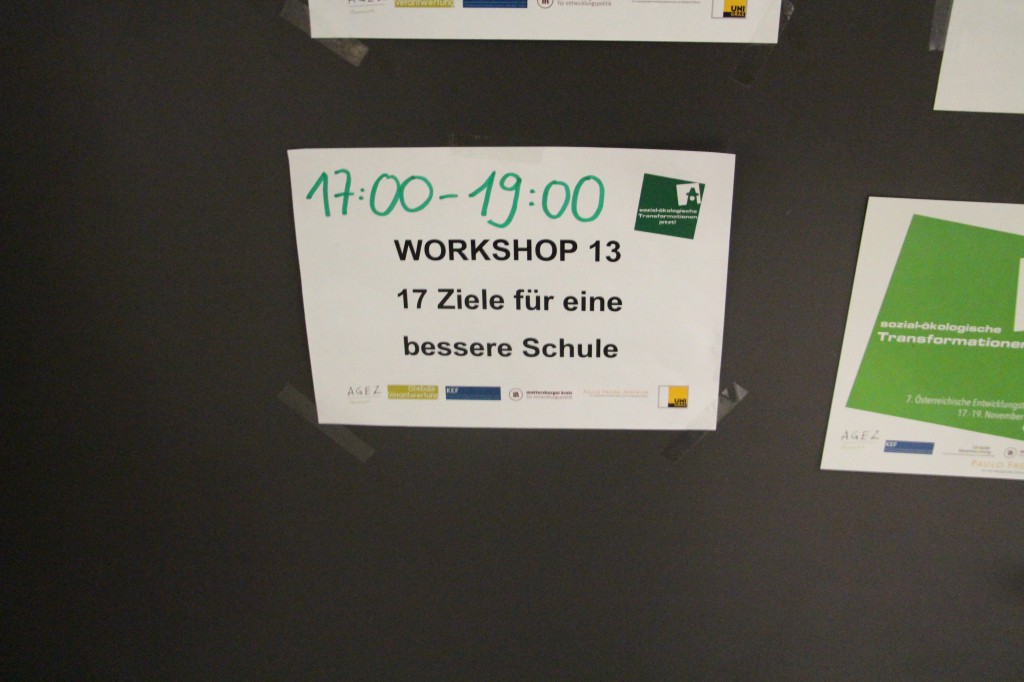
One of the main pillars of the 7. Austrian Development Conference was the Sustainable Development Goals (SDGs). The Workshop 13 „17 goals for a better school – teaching and Learning about SDGs” presented a possible way to implement these goals among young people. (inkl. deutscher Zusammenfassung)
The lecturer of the seminar, Ingrid Schwarz, works as a regional office manager at Südwind in Lower Austria and as a lecturer at the University of Vienna and KPH Vienna / Krems. Furthermore, she is active in municipal education work. Her college, Franz Halbartschlager, works at the Office of Südwind in Vienna. Südwind is based on the objectives of the Austrian Information Service for International Development Policy and it has been active since 1979. Its international development expertise is based on Global Learning programs and international development education and it works in cooperation with numerous international organisations.
The intention of this lecture was to set goals for a „better school” by training “teachers” how to explain about the 17 Sustainable Development Goals (SDGs) in framework of seminars. In this case, seminars are tools where teachers can learn implementing methods for global learning, based on the fourth SDGs goal which aims to “Ensure inclusive and equitable quality education and promote lifelong learning opportunities for all”. In another word, the aim of the sustainable goals is to introduce and to establish a Global Citizenship Education for all.
Teaching SDGs?
The workshop was divided into 3 main parts. In the first session, the United Nation’s Sustainable Development Goals were discussed in more details as well as the possible application of the goals in schools. Explaining the theoretical background of the workshop the attempt was to reflect on contemporary aim of development and modernization programs. Thus, it was also questioned whether economic growth is still the most important factor in development programs or whether economic frames are changing to ensure place for social and cultural dimensions. The lecturers emphasized that teacher seminars are in the role of contemporary tools to reach disseminators for the SDGs. New perspectives of teacher’s education and further training programs and certain methods were discussed.
Together we are stronger.
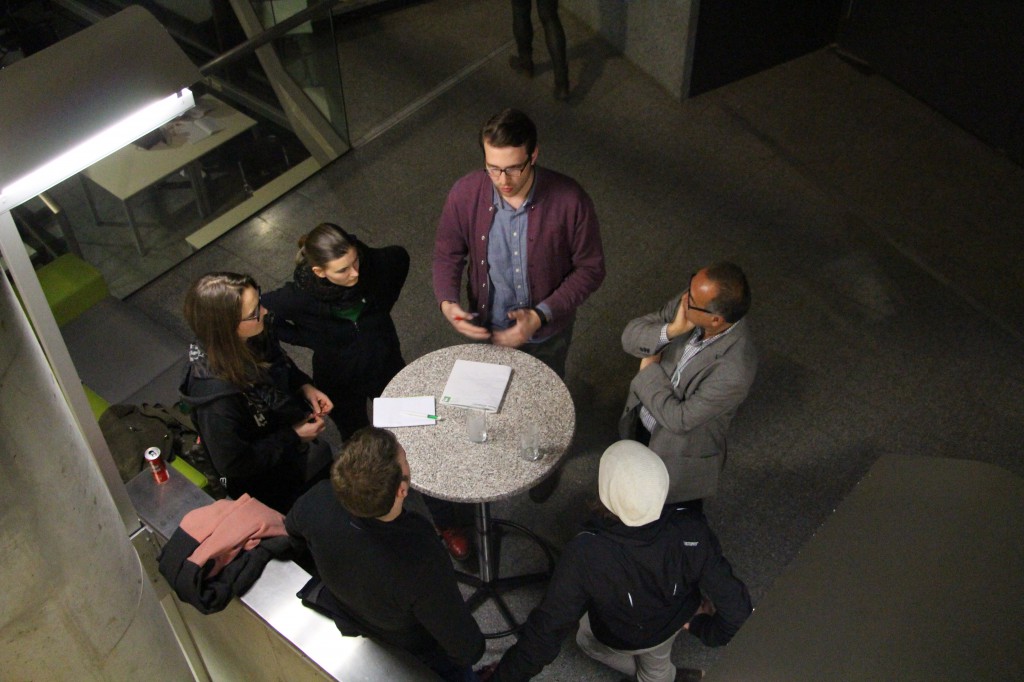
In the second and very collaborative session, the participants searched for answers to questions in two parts. Firstly, participants had to give answers to challenges teachers are facing while giving lectures about important social and political topics. While the lecturers asked the participants to answer certain questions on an imaginary scale, they managed to size up participants’ consciousness of development aid programs and environmental issues. The two extreme points of the scale was placed in the two ends of the room and participants could freely decide whether they absolutely agreed with the lecturers’ statements or whether they completely rejected it. Any kind of answer was possible to give between these two extremes. This “game” made it possible to reflect on the personal standpoint, the institutional structure of education and the development potential of these.
Another point of the discussion was to find strategies in order to overcome challenges and to introduce discussions about socio-ecological transformations into the field of education. Accordingly, both lecturers and participants tried to study the contribution of school education in the dissemination and implementation of the SDGs by playing a card game. In the game, the participants had to give an answer to thematic questions based on these 17 goals. This associative game made it possible to reflect on development acts, monitoring their consequences and to develop alternative strategies. The framework of communal game made it clear that to achieve better results, team work is required, but not only during a game but also in reality.
Guide for Taking Action.
It was agreed that it is very important to express our thoughts and this is something that should also be taught to children. In the practice for example, Südwind called for young people’s participation about the topic of nutrition with the motto “Consumption with awareness”. The aim of this initiative was to call attention to the limits of economic growth and to the importance of fair trade. Consequently, children and young people’s social and environmental awareness and consciousness can be strengthened by playful teaching.
Concluding, it is possible to state that the lecture was very interactive and it was very positive to see that all participants enjoyed the workshop. According to the remarks of participants, one of the most urgent problems is the current functioning of political agendas. It was also emphasized that transnational organisations have only little impact on the politics of nation states. Therefore, the first and maybe most important step would be to involve and to impinge nation states to take part in the implementation of common global goals and transnational projects. The aim of these projects should be foremost to provide chance to all international actors by establishing participatory democracy and therefore, international dependency relations have to be expressed and broken down. Moreover, it is very important that participation has to take place both on global, national and local levels, integrating members of society with their own experiences, lives and aims. Consequently, development has to take place both on an individual and communal level.
Die Autorin ist Soziologin, Reaktionen bitte an redaktion@pfz.at
Deutsche Zusammenfassung:
17 Ziele für eine bessere Schule: SDGs lehren und lernen.
Workshop 13 der 7. Entwicklungstagung behandelte die Frage, wie Wissen über die Sustainable Development Goals (SDGs) junge Menschen in Schulen erreichen könne. Besonders SDG4, das allen Menschen inklusive, chancengerechte und hochwertige Bildung sowie Möglichkeiten zum lebenslangen Lernen gewähren soll, wurde diskutiert.
SDGs lehren.
Geleitet von Ingrid Schwarz (Südwind Niederösterreich) und Franz Halbartschlager (Südwind Wien), teilte sich der Workshop in drei Teile. Im ersten Abschnitt wurden die besagten UN-Nachhaltigkeitsziele im Detail besprochen und überlegt, wie sie möglicherweise in Schulen implementiert werden können. Es wurden aktuelle Entwicklungs- und Modernisierungsprogramme kritisch betrachtet: Die TeilnehmerInnen fragten sich etwa, ob Wirtschaftswachstum noch immer der wichtigste Faktor bei derartigen Programmen sein sollte oder man nicht verstärkt Rücksicht auf soziale und kulturelle Dimensionen nehmen müsse. In diesem Zusammenhang wurden die wichtige Rolle der LehrerInnen und notwendige neue Perspektiven auf deren Ausbildung betont.
Raum für Meinungsaustausch.
Im zweiten Teil des Workshops analysierten die TeilnehmerInnen, mit welchen Schwierigkeiten sie sich angesichts der Vermittlung sozial-politischer Themen wie Umwelt und Entwicklung konfrontiert sehen und wie man diesen Schwierigkeiten begegnen kann. Es wurden die institutionellen Strukturen dahingehend untersucht, das Thema sozial-ökologische Transformationen für die gemeinsame Diskussion zu öffnen. Letztlich könnten die SDGs auch nur durch Team-Work umgesetzt werden.
Konkreter Handlungsplan.
Im letzten Teil rekapitulierten die TeilnehmerInnen die wichtigsten Ziele für die Zukunft. Man war sich über die Wichtigkeit einig, Kinder in der Schule zu ermuntern, ihre Meinung zu äußern. Ebenso müsse man auf spielerische Art Bewusstsein über Grenzen wirtschaftlichen Wachstums und nachhaltigen Konsum schaffen.
Das größte Hindernis in Bezug auf diese Vorhaben sahen die WorkshopteilnehmerInnen in den Agenden politischer Institutionen. Transnational bzw. international arbeitende Organisationen hätten leider nur wenig Einfluss auf einzelne Nationalstaaten. Es sei notwendig, vor allem auf nationalstaatlicher Ebene an der Verbreitung und Umsetzung von gemeinsamen Nachhaltigkeitszielen zu arbeiten. Internationale Abhängigkeiten sollten aufgelöst werden, indem alle internationalen Akteure von einer partizipativen Demokratie profitieren. Diese Form der Demokratie müsse auf globaler, nationaler und lokaler Ebene implementiert werden.
Weiterführende Links:
– https://www.pfz.at/article1929.htm
– https://sustainabledevelopment.un.org/
Fotos: Fabian Franta ©Paulo Freire Zentrum