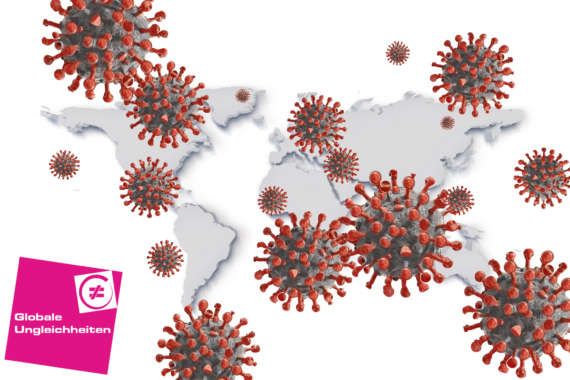
The COVID-19 pandemic hasn’t “equalized” anything – despite the fact that some state leaders got the virus, they are not affected in the same way as marginalized people all over the world. In almost every region of the world thus far, the highest numbers of Covid-19 fatalities have occurred in countries where the gap between the rich and poor is the widest. Brazil, the most unequal country in Latin America, has by far the highest number of infected persons. The same applies to South Africa and the United States. There and elsewhere, the link between inequality and high infection rates can be shown right down to the regional and sometimes even local level.
The effects of the Covid-19 pandemic come on top of existing inequalities within and between countries. According to Oxfam, “the world’s 2,153 billionaires have more wealth than the 4.6 billion people who make up 60 percent of the planet’s population.” Deepening this gap, the pandemic has left the world more unequal.
In addition to its severe health effects and its death toll, we are witnessing a massive increase in unemployment, a pauperization of already precarious and vulnerable parts of the population, and the implementation of partly questionable authoritative measures.
The Covid-19 crisis is causing a social, economic and political crisis of unforeseeable duration. The victims are often already marginalized members of society for whom home office, social distancing or distance learning are not an option or have fatal consequences. There is no question that Covid-19 is further exacerbating global inequalities. Existing imbalances are being reinforced.
Even countries in which the number of cases has remained low are today struggling with a decline in foreign investment, a drastic decline of commodity prices, tourism, currencies and migrant remittances, export losses and capital flight of historic proportions. The poorest sections of the population, who have to lead a hand-to-mouth existence, even in “normal times”, suffer hunger and misery caused by the abrupt shutdown of the economy.
Moreover, authoritarian regimes are abusing the protective measures against the pandemic to suppress progressive political forces. International human rights organizations report an alarming number of violations of press freedom and attacks on activists.
In this #webET2020 we will therefore discuss the impact of Covid-19 on global inequalities with our international guests. In 4 online dialogues we will take a closer look at individual world regions, as the dynamics here are very different.