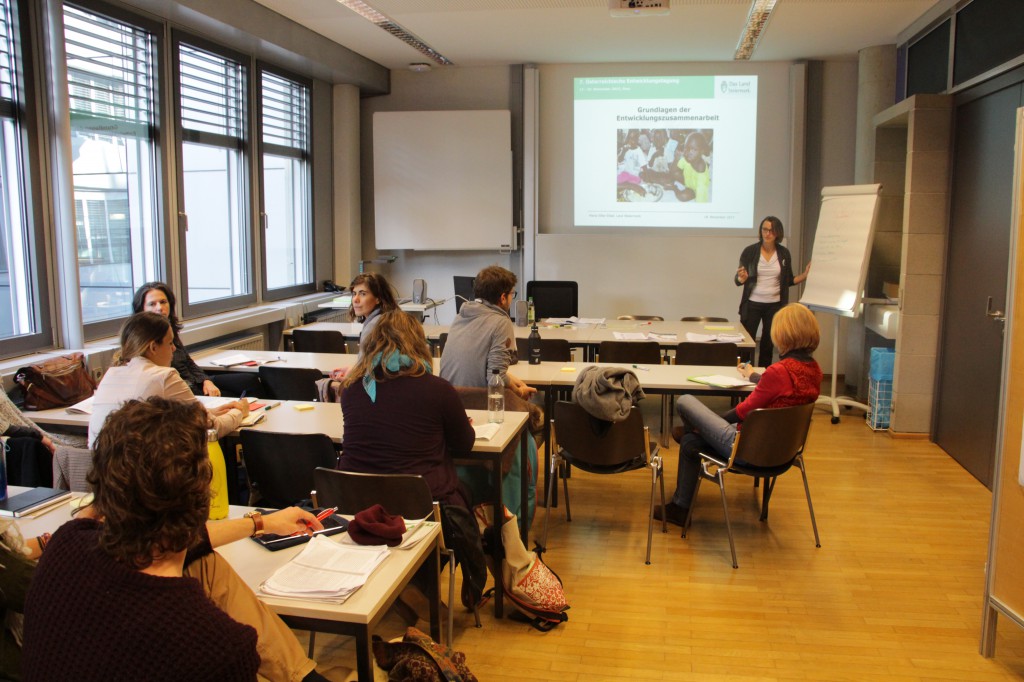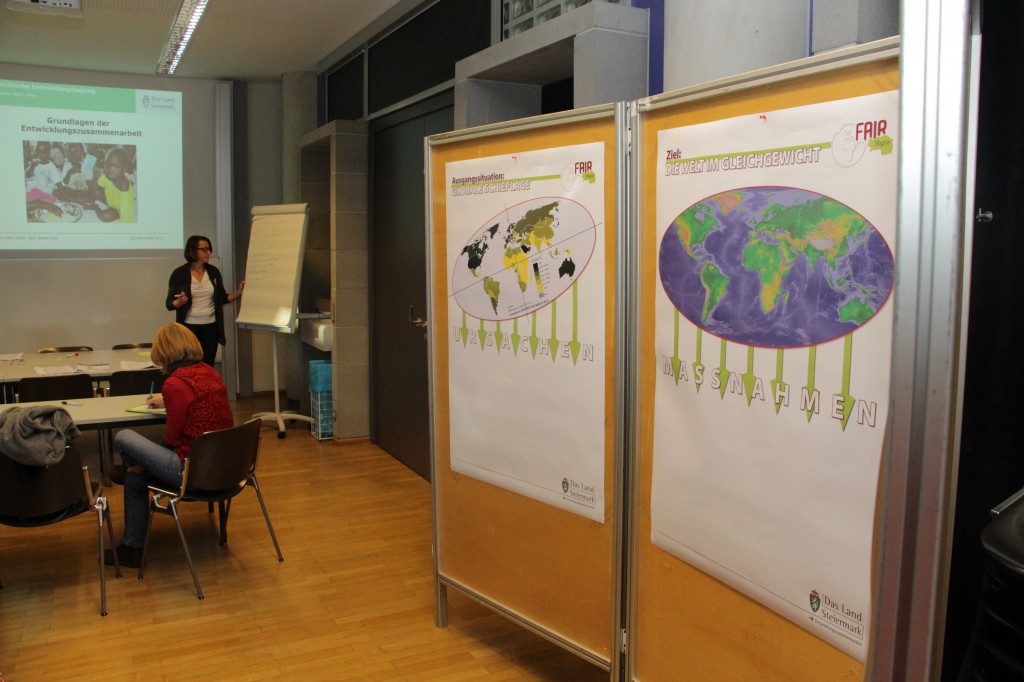
On the second day of the 7. Austrian Development Conference with the motto “socio-ecological transformations now!”, Maria Elßer-Eibel contributed with her workshop “Grundlagen der Entwicklungszusammenarbeit mit praktischen Beispielen”. (inkl. deutscher Zusammenfassung)
The workshop about International Development Cooperation aimed at discovering the unequal relationship between the Global North and the Global South. The lecturer – Maria Elßer-Eibel – is working at FairStyria in Styria federal state. Basing herself on her own experiences, she explained how development aids and development programs “work” in the context of colonialism. After that, brain storming and active participation helped finding possible ways to share responsibilities globally. Finally, by explaining the structure and objectives of FairStyria, Maria Elßer-Eibel provided important insights into the implementation of development programs.
Measuring development?
Already at the beginning, it had to be stated that very unfortunately, two-thirds part of the world population still lives under precarious conditions and about 800 million people are threatened with starvation. Not only women and men, but also children have to face death because of different diseases and poor sanitary conditions. In order to measure the quality of life, the access to health care and education, different methods were developed like HDI (Human Development Index), PPP (Purchasing Power Parity) or MPI (Multidimensional Poverty Index) etc. However, the belief in development and modernization got soon challenged because of remaining inequalities, injustice and poverty.
Alternative ways of measuring development.
Although natural catastrophes, natural and regional characteristics of regions and epidemics also influence the course of history, Elßer-Eibel called attention to the fact that capitalism and colonialism are the two most important processes responsible for the disparities between North and South. The logic of imperialism is based on creating differences between groups of people, labelling them to be “inferior” and served as a means to apply the extensive capitalist logic and economic interest of colonizers. Thus, a critical understanding is required to understand the historical development and structural determination of these problems, emphasised Elßer-Eibel. Concepts like Buen Vivir, Gutes Leben für alle, BNG (Gross National Happiness) and the Ubuntu philosophy appeared as alternative measures and set the goal to lead humans back to their origins and to overcome inequalities.
The world equilibrium is in danger.
It must be highlighted that the end of the WWII did not lead to the elimination of world inequalities and colonialism, since production for industrialized countries still takes place under precarious and inhumane conditions in the Global South. Therefore, it must be considered critically whether development aid programs contribute to resilience and self-reliant development or rather deepening existing differences. The existing differences are results of exploitation of indigenous people since colonial times, which deprived them from the right to education and development. Population in developing countries are forced to flee from persecution, violence and human rights violations. Moreover, the above-mentioned processes have huge socio-ecological impacts on people living in the Global South. Heavy consumption is responsible for deterioration of lands and pollution leads to the loss of ecosystems, explained Elßer-Eibel.
But what could be done?
Including the participants’ observations, firstly and mainly consumer habits should be changed and along with this there should be a better distribution of wealth which is hardly possible without ethical world trading (Fairtrade), political participation and education of people, transparency and reduction of influence of international actors.
Among the most prestigious institutions are the United Nations, WHO, WTO, World Bank, etc. The United Nations released its Millennium Development Goals program in 2000 (expired at the end of 2015). From 2016 the Sustainable Development Goals program is responsible for setting up a peaceful cooperation and partnership for sustainable development until 2030. According to statistics, the EU contributes to achieving the goals with 75,5 Mrd. Euro. Austria’s share in this 1,43 Mrd. Euro which is 0,41% of its BNI (Brutto National Income). Although development cooperation aims to achieve sustainability, it has to be kept in mind that aid has to remain help in all cases and this is only makeable by respecting people’s social and cultural characteristics and traditions.
A possible solution – Glocalization?
By the end of the workshop, the focus was shifted from the global level to the local one. To get an insight into real project implementations, first, the video of “Palabre de mujer” – “The voice of women” was displayed. Afterwards, Elßer-Eibel emphasized how FairStyria takes place in international development cooperation. Regionally (in Styria state), there is development cooperation since 1981. Since 2006 FairStyria has tasks as interagency for global cooperation and became an umbrella brand for the province. With the Global Marshall Plan initiative, FairStyria aims to lay the basis for an eco-social market economy and it also takes part in promotion of international aid, political education and in different Fairtrade programs. These programs engaged in combating rural and urban poverty, eliminating child labour and providing people with an access to health care services. It also provides support for women and other disadvantaged groups to help them with a social, economic and political independence. By supporting literacy, further education and vocational training programs, FairStyria is an integrate part of global actions.
Die Autorin ist Soziologin, Reaktionen bitte an redaktion@pfz.at
Deutsche Zusammenfassung des Artikels: Grundlagen der Entwicklungszusammenarbeit mit praktischen Beispielen.
Moderiert von Maria Elßer-Eibel (FairStyria) befassten sich die TeilnehmerInnen von Workshop 11 der 7. Entwicklungstagung mit „Grundlagen der Entwicklungszusammenarbeit mit praktischen Beispielen“.
Ziel war es, ungleiche Machtverhältnisse in der EZA zwischen Globalem Norden und Globalem Süden und deren kolonialen Kontext zu verstehen. Im Anschluss überlegten sich die TeilnehmerInnen gemeinsam die Möglichkeiten, Verantwortung global aufzuteilen. Zuletzt stellte Maria Elßer-Eibel die Organisation FairStyria näher vor.
Entwicklung messen ohne Bias.
Es gebe in der EZA eine Reihe von Indikatoren, die darauf abzielen, Lebensstandard, Gesundheit oder Bildung verschiedener Gesellschaften zu quantifizieren und „Entwicklung“ anhand dieser Zahlen zu messen. Den Zahlen zufolge, leben zwei Drittel der Weltbevölkerung noch immer in prekären Verhältnissen und etwa 800 Millionen Menschen in Hungersnot, so Maria Elßer-Eibel eingangs.
Dann blickte sie hinter die Zahlen und ging der Problemlage auf den Grund: Neben naturräumlichen und regionalen Charakteristika seien in erster Linie globaler Kapitalismus und Kolonialismus verantwortlich für das Ungleichgewicht zwischen Nord und Süd. Die imperialistische Logik basiere nämlich darauf, einzelne Bevölkerungsgruppen für „minderwertig“ zu erklären, um daraus ökonomische Vorteile für die „überlegenen“ Kolonisten herauszuschlagen. Dies gelte es zu bedenken, wenn man die Zahlen wirklich verstehen möchte. Vielversprechendere Maßstäbe für Entwicklung sehe Elßer-Eibel daher in alternativen Konzepten wie „Buen Vivir“ oder dem Guten Leben für Alle. Diese erkennen Menschen und Lebensweisen grundsätzlich als gleichwertig an, analysieren Machtverhältnisse und haben das Ziel, diese Gleichwertigkeit auch zu realisieren.
Die Welt im Ungleichgewicht.
Es müsse hervorgehoben werden, dass das Ende des zweiten Weltkrieges eben nicht automatisch zur Eliminierung von Imperialismus und Kolonialismus führte, da seither die Produktionskette der globalisierten Weltgesellschaft den Kolonialismus und Imperialismus weiterführe und globale Ungleichheiten reproduziere. Die sozial-ökologischen Folgen dieser kapitalistischen Globalisierung, des ausbeuterischen Konsums vor allem der Gesellschaften des Globalen Nordens, treffen die Gesellschaften des Globalen Südens besonders hart, so Elßer-Eibel.
Was kann man tun?
Gemeinsam überlegten die Workshop-TeilnehmerInnen schließlich, wie man gegen diese Missstände vorgehen könnte. Sie nannten Konsumgewohnheiten und Vermögensverteilung als Faktoren, die verändert werden müssen. Damit einhergehen müsse ein fairer Handel, gleichverteilte politische Partizipation und Bildung, Transparenz und ein Ende der Vormachtstellung der Industriestaaten. Programme der EZA, (gerade) auch prestigeträchtiger Institutionen wie die Vereinten Nationen oder die Weltgesundheitsorganisation, müssten immer kritisch daraufhin untersucht werden, ob sie tatsächlich zur Eigenständigkeit sogenannter „Entwicklungsländer“ beitragen oder in Wahrheit die existierenden Hierarchien verstärken.
FairStyria setze sich international vor allem für politische Bildung und eine öko-soziale Marktwirtschaft basierend auf fairem Handel ein, erläuterte Elßer-Eibel daraufhin. Durch diverse Programme unterstütze die Organisation benachteiligte Gruppen und fördere deren Unabhängigkeit. Dies sei aber nur möglich, wenn man sämtliche Bevölkerungsgruppen mitsamt ihren Charakteristika und Traditionen gleichen Respekt entgegenbringe, betonte sie abschließend.
Weiterführende Links:
– Fairstyria: https://www.fairstyria.at/
– Zur Seite der Entwicklungstagung: www.entwicklungstagung.at
– Zu weiteren Artikeln über die Tagung: https://www.pfz.at/list193.htm
Fotos: Fabian Franta ©Paulo Freire Zentrum